Defibrillator (AED) Training at Your Workplace
A focused three-hour session that gives your team hands-on practice with a real AED training unit — so that if a colleague ever goes into cardiac arrest, nobody hesitates. Delivered on site at your premises, anywhere in the UK.
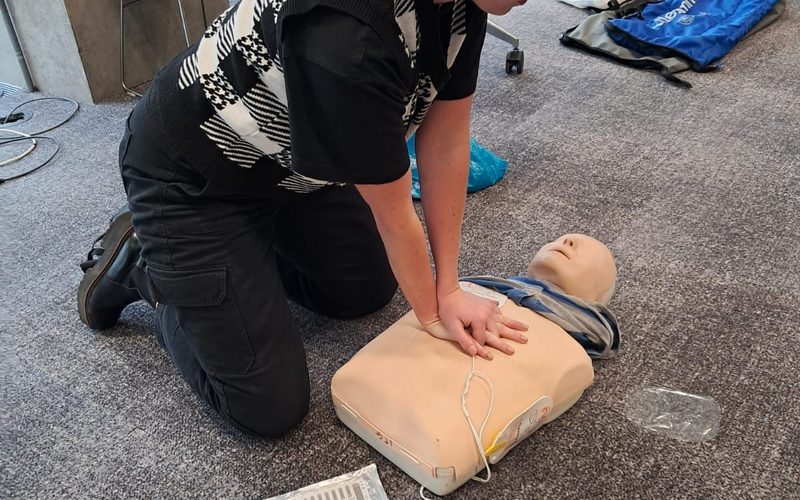
Why your team needs defibrillator training — not just an AED on the wall
A workplace AED is one of the most valuable pieces of safety equipment you can install. But research and real-world experience consistently show that the device's impact depends heavily on whether bystanders feel confident enough to use it straight away. In a sudden cardiac arrest, every minute without defibrillation reduces the chance of survival. Hesitation costs lives.
Public-access AEDs are deliberately designed with voice and visual prompts so that anyone can follow them. Even so, in the shock of a real emergency, unfamiliar equipment — the pads, the connections, the "stand clear" safety checks — can cause critical delays. This course removes that uncertainty entirely. Your team will work with a training AED, run through realistic scenarios, and leave the session with the hands-on experience and calm confidence that makes the difference when a real emergency happens.
Who is this course for?
Defibrillator (AED) training at your workplace is suitable for any organisation that has installed an AED, is planning to purchase one, or simply wants its staff to be better prepared for a cardiac emergency. There is no first aid prerequisite — the course is designed to be genuinely accessible, whether your team are complete beginners or already hold first aid certificates.
It is particularly well matched to:
- Office and facilities teams — receptionists, building managers, and floor wardens who are first on scene
- Schools and colleges — all teaching and support staff, especially in settings where the DfE has already supplied an AED
- Sports clubs and leisure centres — coaches, officials, gym instructors, and activity leaders
- Retail and hospitality environments — staff who are regularly in contact with members of the public
- Warehouses and industrial sites — where a cardiac event could occur in an area remote from the building entrance
- Care homes and supported living settings — where clinical confidence matters and annual refreshers are expected
It also works as a targeted refresher for existing first aiders who want deeper, dedicated practice on the AED — going further than the brief AED element included in a standard EFAW or First Aid at Work course.
What your team will learn — full syllabus
The session blends short explanations with immediate hands-on practice. By the end, every participant will be able to:
- Recognise sudden cardiac arrest — understanding the difference between a cardiac arrest (electrical failure, person collapses, unresponsive and not breathing normally) and a heart attack (a blockage, person is typically conscious and in pain; CPR and an AED are for cardiac arrest, not a heart attack)
- Respond immediately — calling 999, directing bystanders to fetch the nearest AED, and beginning CPR without delay
- Perform effective CPR for adults — correct hand position, compression depth (5–6 cm), rate (100–120 per minute), and full chest recoil; why minimising "hands-off" time matters
- Switch on and follow the AED — powering the device, following voice prompts step by step, and working calmly through the full shock cycle
- Place electrode pads correctly — standard adult placement, the paediatric pad positions used for children, and what to do when the chest is wet or hairy
- Understand how an AED makes decisions — the device reads the heart's rhythm and only enables a shock for shockable rhythms (ventricular fibrillation and pulseless ventricular tachycardia); it will not shock a normal or non-shockable rhythm and cannot harm the casualty
- Apply essential safety checks — standing clear during analysis and shock delivery; managing risks from wet surfaces, supplemental oxygen, transdermal medication patches, implanted pacemakers or defibrillators, and metal jewellery
- Integrate AED and CPR seamlessly — continuing compressions while the AED analyses and charges, switching roles in a two-rescuer scenario, and keeping hands-off time to an absolute minimum
- Hand over to paramedics — what to say and do when the ambulance arrives, ensuring a smooth transfer of care
- Maintain the device — carrying out regular visual checks of pad expiry dates, battery indicator status, and the device's self-test light so it is always ready for use
How the session runs
Your trainer comes to you — no venue hire, no travel costs, no lost half-days commuting. On arrival, they set up quickly and begin with a brief, plain-English explanation of how the heart works and what happens during a cardiac arrest. The theory element is kept short and focused; the session moves into practical work as soon as possible.
Participants take turns at the manikin — practising chest compressions, attaching the training pads, and following the AED through an analysis and shock cycle. The trainer adjusts technique in real time and coaches anyone who needs extra support. The atmosphere is relaxed and informal; many teams tell us they were surprised by how approachable the topic turned out to be.
The full session runs for approximately three hours, including a realistic scenario (or two, for a small group) and time for questions at the end. There is no written exam and no pressure — just practical repetition until every person in the room feels ready.
Assessment and certificate
There is no written paper or formal exam. Assessment is continuous and entirely practical — your trainer observes technique throughout the session and offers coaching where needed. Every participant who completes the course receives a Certificate of Attendance from First Aid Training On Site, issued the same day. This is an in-house certificate: the course is not regulated by an external awarding body. It documents training for staff records and is suitable as evidence of workplace AED competency.
Most organisations schedule a short refresher annually to keep skills current and confidence high. We offer a dedicated Annual First Aid Refresher (also three hours, also on site) that covers CPR, AED, choking, and the recovery position.
Why bring AED training on site?
The fixed-price, on-site model is designed around one thing: making good training as easy as possible for a busy organisation to say yes to.
- One flat price for up to 12 people — from £395 + VAT. That works out to less than £33 per head for a full group. Send 12 people on individual public courses and the cost is typically three to four times higher, before you add travel time and disruption.
- No travel, no venue costs, no lost productivity. Your team trains in your own building. There is no commute, no overnight stay, and no period when 12 people are away from their desks, the production line, or the shop floor.
- Tailored to your setting. Your trainer can walk the group to where your AED is mounted, point out the nearest clear space for compressions, and run scenarios that reflect your actual workplace layout — something an open course at an off-site venue simply cannot do.
- Dates and times to suit your rota. We work around your hours, your shifts, and your busiest periods. If early morning or late afternoon works better, we can accommodate that.
- All equipment included. Your trainer arrives with CPR manikins, AED training units, face shields, and all supporting materials. You provide a room and somewhere to park — we handle everything else.
AED standards and legal context
There is currently no legal requirement under UK law for most workplaces to install an AED. However, the Health and Safety (First-Aid) Regulations 1981 require every employer to make adequate first aid provision — and a first aid needs assessment should consider the risk and likely response time of the ambulance service for your location. For sites that are remote, have a high volume of public footfall, employ large numbers of staff, or have a workforce with particular health risk factors, installing an AED and training staff to use it is a prudent and widely recommended step.
The Department for Education has already funded AEDs for all state-funded schools in England, and the expectation is that designated staff know how to use them. Sports governing bodies and leisure sector regulators increasingly expect AED competency from staff who supervise physical activity. Where your organisation has an AED on the premises, training the people most likely to reach it first is simply good practice — and this course is the most practical way to deliver it.
Common questions about defibrillator (AED) training
Do we need to own an AED before booking this training?
No. Your trainer brings a purpose-built AED training unit so every participant can practise safely without any risk. If you already have an AED installed on your premises, we are happy to use your actual device during the session so staff learn on the machine they would reach for in a real emergency.
Is there any first aid experience needed to attend?
None at all. The course is designed to be accessible to everyone — whether your team have never attended any first aid training or already hold EFAW or First Aid at Work certificates. It works well as a standalone course and as a useful complement for existing first aiders who want to sharpen their defibrillator confidence specifically.
Can an AED accidentally shock someone whose heart is beating normally?
No. An AED analyses the heart's rhythm before it does anything. It will only enable a shock for shockable rhythms — ventricular fibrillation or pulseless ventricular tachycardia. If the rhythm is not shockable, the device advises "no shock" and prompts the rescuer to continue CPR. It is not physically possible for an AED to deliver a shock inappropriately, which is one of the key points covered in the session — and one that immediately puts anxious participants at ease.
What certificate do participants receive?
Everyone who completes the course receives a Certificate of Attendance from First Aid Training On Site, issued the same day. This is an in-house certificate documenting your team's AED training and is suitable for staff records and evidence of workplace competency. The course is not regulated by an external awarding body.
How many people can attend and what if our group is larger than 12?
Each session accommodates up to 12 participants — the size that allows everyone meaningful hands-on practice time. If your team is larger, we can run consecutive sessions on the same day or across different dates, whichever suits your operation better. Each session is priced at from £395 + VAT, so the per-head cost stays low even across multiple groups.
How often should AED training be refreshed?
Annual refresher training is widely recommended for anyone with AED responsibilities in a workplace. Practical skills — CPR technique, pad placement, safety checks — fade with time, and a short annual session keeps confidence high and absorbs any protocol updates. Our Annual First Aid Refresher covers CPR, AED, choking, and the recovery position in three hours on site.
What do we need to provide on the day?
Just a clear indoor space large enough for participants to kneel and practise compressions comfortably — a meeting room, training area, or a cleared section of floor works well. Your trainer brings all the equipment: CPR manikins, AED training units, face shields, and supporting materials. Parking nearby or a convenient unloading point is helpful. That is genuinely all we need from you.
Is this the same as the AED element in an EFAW course?
The Emergency First Aid at Work (EFAW) course does include a practical AED element, but the entire course covers many topics in a single day, so AED time is limited. This dedicated three-hour session focuses entirely on the AED and CPR together. Participants get far more hands-on repetition, deeper coverage of safety considerations (pacemakers, medication patches, wet surfaces, paediatric pads), device maintenance checks, and multiple scenario runs. It is ideal for staff who will not be taking the full EFAW, or as a targeted AED session on top of an existing first aid qualification.
Related courses
Round out your team's life-support skills with one of these closely related courses — all delivered on site at your premises.
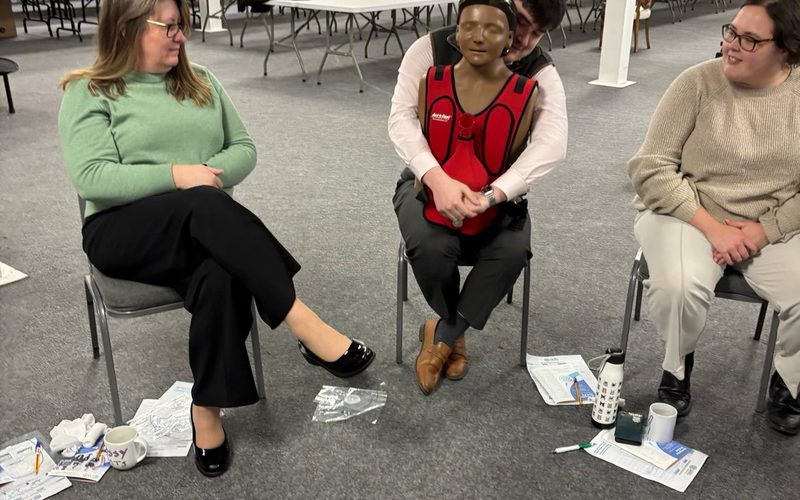
CPR Certificate Course
Hands-on CPR for adults, children, and infants — the skill that works alongside your AED in every cardiac emergency.
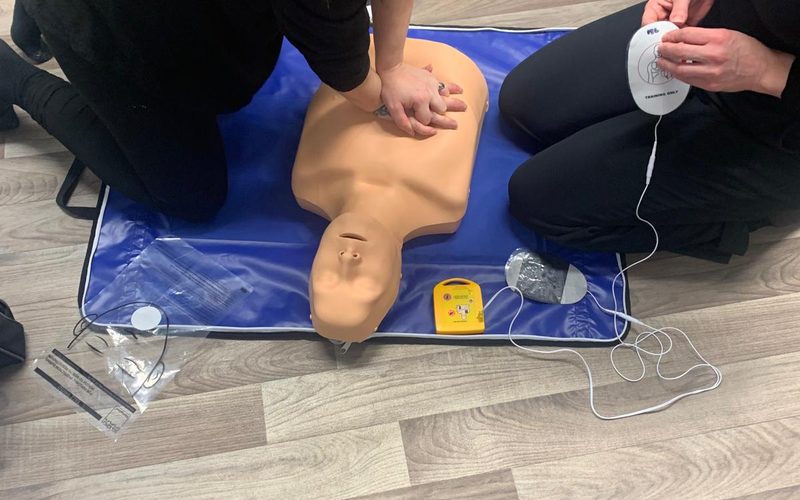
Basic Life Support (BLS)
CPR, AED, choking response and airway management for care homes, clinical settings and healthcare teams.
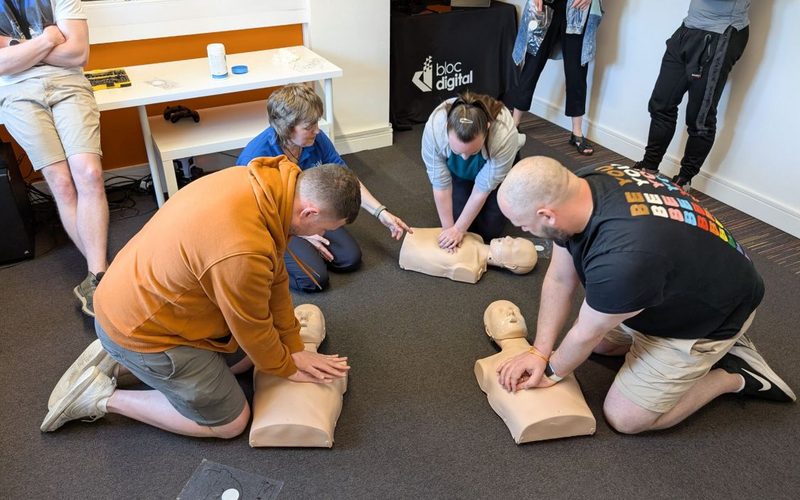
Emergency First Aid at Work (EFAW)
One-day FAIB-accredited workplace first aid for lower-risk sites — three-year certificate, covers AED, CPR, and more.
Ready to book defibrillator (AED) training at your workplace?
One fixed price for up to 12 people, all equipment included, delivered at your UK premises on a date that suits you. Get a quote in minutes.