First Aid at Work (3 Day) — Delivered at Your Workplace
The full FAIB-accredited First Aid at Work (3 Day) qualification, delivered on site at your premises anywhere in the UK. Blended format — e-learning theory plus hands-on practical days. One fixed price for up to 12 people.

The definitive workplace first aid qualification
The First Aid at Work (3 Day) course is the most comprehensive workplace first aid qualification available in the UK. Where the one-day Emergency First Aid at Work certificate covers urgent response basics, the full FAW programme equips your nominated first aiders to handle a genuinely wide range of medical emergencies — from severe trauma and chemical burns through to heart attacks, strokes and anaphylaxis.
We deliver it as a blended programme: learners work through self-paced e-learning covering the theory, then your trainer comes directly to your premises for the hands-on practical days. The course totals 18 contact hours, meeting the full regulatory standard — and because we come to you, your team never sets foot outside your building to get certified.
Who is this course for?
The First Aid at Work (3 Day) at your workplace is the right choice when a first aid needs assessment — required under the Health and Safety (First-Aid) Regulations 1981 — identifies a higher level of risk. That typically means:
- Manufacturing and production facilities — machine operators, assembly workers, production-line staff
- Warehousing and logistics — forklift and vehicle movements, heavy loads, lone workers on shift
- Construction and civil engineering sites — working at height, plant, power tools
- Engineering workshops and fabrication — lathes, presses, cutting machinery, welding
- Chemical and industrial plants — hazardous substances, COSHH environments
- Larger organisations (50+ employees in medium-hazard settings) where HSE guidance suggests one FAW-trained first aider per 50 employees
- Any workplace where a previous incident history or risk profile points beyond the emergency basics
If your workplace is lower-risk — an office, salon, shop or similar — our one-day Emergency First Aid at Work course is usually the right fit and costs less. Not certain which applies? Call us on 0800 852 7739 and we will walk you through it in a few minutes.
What your team will learn
The First Aid at Work (3 Day) on site programme covers the full regulated FAW syllabus. Below is what your first aiders will be able to do confidently by the end of the course:
Legislation, responsibilities and the first aider's role
- The Health and Safety (First-Aid) Regulations 1981, RIDDOR and COSHH — what they mean for your first aider and for you as an employer
- First-aider liability, duty of care and the limits of the role
- Preventing cross-infection — personal protective equipment, hygiene protocols
- Recording incidents and completing first aid documentation accurately
- First aid kit contents and responsibilities for equipment maintenance
Emergency response and life support
- Assessing an incident — scene safety, primary survey, calling for help
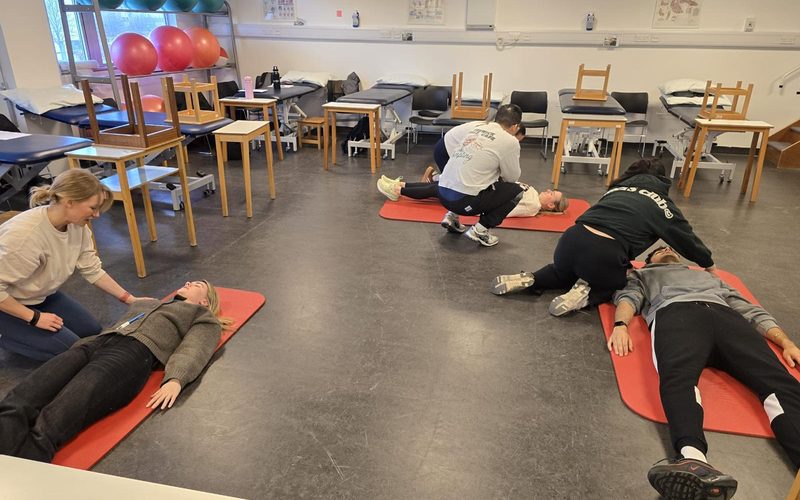
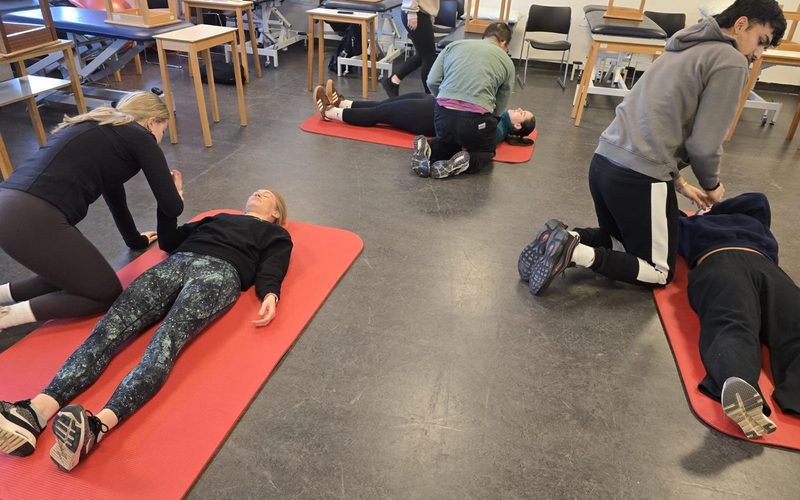
- Managing an unresponsive casualty — airway, breathing checks, recovery position
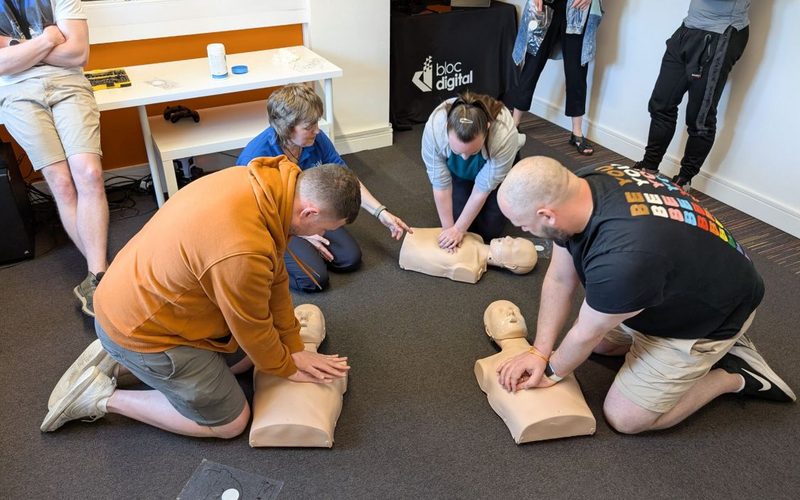
- CPR for adults — correct rate, depth and technique; minimising interruptions
- Safe and confident use of an Automated External Defibrillator (AED)
- Choking — recognition, back blows and abdominal thrusts in conscious and unresponsive adults
- Seizures and epilepsy — safety positioning and when to call 999
Wounds, bleeding and shock
- Minor wounds — cuts, grazes, blisters, splinters, nosebleeds, bites and stings, eye injuries
- Severe and life-threatening bleeding — control techniques, tourniquets, wound packing (where appropriate)
- Shock — recognition and management
- Abdominal wounds, amputations, crush injuries and penetrating chest wounds
Musculoskeletal and head injuries
- Fractures and dislocations — recognition, immobilisation and when not to move
- Strains and sprains
- Spinal injuries — assessment, managing an unresponsive casualty with a suspected spinal injury
- Head injuries, skull fractures and signs of concussion — when to seek immediate emergency care
- Chest injuries — recognition and first aid management
Burns, scalds and hazardous exposures
- Assessing burn depth and extent — superficial, partial-thickness and full-thickness
- Immediate treatment for thermal burns and scalds
- Electrical burns — safety first, then casualty management
- Chemical burns to skin and eyes — flushing, decontamination and specialist referral
- Inhalation injuries and exposure to fumes or gases
Medical emergencies
- Heart attack — recognising symptoms, position of comfort, calling 999 promptly
- Stroke — the FAST check and urgent action
- Diabetic emergencies — hypoglycaemia and hyperglycaemia; when to give sugar and when not to
- Epilepsy and seizures — tonic-clonic and other types; status epilepticus
- Asthma — attack recognition, inhaler use and escalation
- Anaphylaxis — recognition of a severe allergic reaction and correct use of an adrenaline auto-injector (e.g. EpiPen)
- Poisoning — ingested, inhaled and injected substances; information for the ambulance crew
How the programme runs
The blended format is designed to make the course as straightforward as possible for your team and your business:
E-learning pre-study
Each learner completes approximately six hours of self-paced online pre-learning covering first aid law, anatomy and theory. They can work through this in their own time before the practical days — at a desk, on a tablet, whenever suits them.
Practical training at your premises
Your trainer arrives with all the equipment — manikins, training AEDs and practical props — and delivers approximately twelve hours of hands-on training across the remaining days. Sessions run through the full syllabus using scenario-based exercises tailored to your workplace and its specific hazards.
Assessment
Assessment is built into the practical days — six observed practical scenarios plus two short multiple-choice knowledge papers. Your trainer gives ongoing feedback as you go; there are no surprise exam conditions.
Certificates issued
Learners who meet the required standard receive the First Aid at Work certificate, valid for three years, on the same day the course ends. Certificates are FAIB-accredited and recognised by HSE as meeting the requirements of the Health and Safety (First-Aid) Regulations 1981.
Assessment and your certificate
The First Aid at Work (3 Day) qualification uses a combination of continuous practical assessment throughout the hands-on days and two short multiple-choice theory papers. Practical skills are observed and assessed across six scenario exercises — your trainer provides guidance and corrective feedback throughout, so learners are not left to guess what is expected.
Successful learners receive the First Aid at Work certificate (valid 3 years). This certificate is FAIB-accredited and is fully accepted by HSE, Ofsted and the vast majority of UK insurers as meeting the requirements of the Health and Safety (First-Aid) Regulations 1981.
The HSE strongly recommends — though does not legally mandate — an annual skills refresher between requalification dates to keep practical skills sharp. When the three-year certificate is approaching expiry, holders can renew via the two-day First Aid at Work Requalification course rather than repeating the full programme.
Why train at your workplace?
The cost comparison that changes minds
Our from £995 + VAT fixed rate covers any group up to 12 people. That works out to:
- Under £84 per person for a full group of 12
- Under £100 per person for a group of 10
- No travel costs for any member of your team
- No lost productivity from commuting to a training centre
- No venue hire, no parking, no away-day catering
Public open courses often charge £250–£350 per delegate for the three-day FAW — before travel. For a team of five or more, on-site training at your workplace almost always costs less in total and causes far less disruption.
Beyond price, training at your own premises carries real practical advantages:
- Zero travel for your team — staff train on site and return to their work immediately afterwards
- Scheduled around you — we fit the dates to your shifts, not the other way round
- Tailored scenarios — your trainer runs exercises in your actual environment: the warehouse floor, the production line, the kitchen. The scenarios reference your first aid kit locations and your specific hazards, so the training sticks
- Whole team certified together — everyone completes on the same date, simplifying your renewal calendar
- UK-wide coverage — whether your site is in central Manchester, rural Wales or the Scottish Highlands, we can get there
What the law requires
Under the Health and Safety (First-Aid) Regulations 1981, every employer must carry out a first aid needs assessment and provide "adequate and appropriate" first aid equipment, facilities and personnel. What counts as adequate depends on your workplace — there are no fixed legal minimums, but HSE's guidance (L74) sets out illustrative benchmarks.
For higher-hazard workplaces with 5–50 employees, HSE guidance suggests at least one EFAW- or FAW-trained first aider; for sites with more than 50 employees in that category, the guidance moves to at least one FAW-trained first aider for every 50 people. Importantly, the 2024 update to L74 added a requirement to consider employees' mental health needs when deciding on first aid provision.
First aid training must be provided free of charge to employees, and your provision must be sufficient to maintain cover across all shifts and in the event of first-aider absence. Certificates must remain current — letting a certificate lapse without cover in place is a gap in your legal duty.
Your questions about First Aid at Work (3 Day) answered
Which workplaces need the full First Aid at Work (3 Day) certificate?
The Health and Safety (First-Aid) Regulations 1981 require every employer to carry out a first aid needs assessment. Where that assessment identifies higher hazard levels — such as manufacturing, warehousing, construction, engineering, chemical handling or anywhere staff operate machinery or work at height — the full First Aid at Work (FAW) qualification is the appropriate standard. Lower-risk workplaces such as offices and retail are typically covered by the shorter one-day Emergency First Aid at Work (EFAW) certificate instead. If you are unsure which applies, give us a call and we will advise you honestly — even if that means recommending a cheaper course.
What is the blended format and how does it work in practice?
The blended First Aid at Work (3 Day) course splits into two stages. Learners first complete a self-paced e-learning module of around six hours covering the underpinning knowledge and theory — they can do this in their own time before the practical element begins. Your trainer then arrives at your premises to deliver approximately twelve hours of hands-on practical training and assessment across the remaining days. This approach keeps time away from day-to-day duties to a minimum while ensuring every learner covers the full regulated syllabus of 18 contact hours.
What is the difference between the one-day EFAW and the three-day FAW?
Emergency First Aid at Work (EFAW) covers core emergency response — CPR, AED use, choking, bleeding and shock — and is designed for lower-risk settings. First Aid at Work (FAW) is the full qualification and goes considerably further. It adds fractures and dislocations, spinal and head injuries, burns including chemical and electrical, anaphylaxis and auto-injector use, major medical emergencies (heart attack, stroke, diabetes, epilepsy, asthma), poisoning, abdominal wounds, amputations and penetrating chest injuries, plus detailed legislation and documentation duties. If your workplace risk assessment points to higher hazards, FAW is what you need.
How long does the First Aid at Work certificate last, and what happens when it is about to expire?
The First Aid at Work certificate is valid for three years from the date of issue. The HSE strongly recommends that certificate holders attend a short annual refresher during this period to keep their practical skills current. When the certificate is approaching its expiry, holders should complete the two-day First Aid at Work Requalification course — a condensed refresh and reassessment of the full syllabus that avoids repeating the complete programme. Requalify before expiry; most awarding bodies only allow a very short post-expiry window before a full course is required again.
Is on-site First Aid at Work (3 Day) training cheaper than sending staff on an open course?
For most teams of four or more people, on-site delivery works out significantly cheaper per head. Our flat rate of from £995 + VAT covers the whole group of up to 12 — that is under £84 per person for a full group of twelve. Public open courses typically charge per delegate, and once you add travel time and costs for each learner, on-site training at your workplace almost always represents better value. And your team never has to leave the building.
What do we need to provide on the training days?
Very little. You need a private room large enough for the group to move around comfortably — with chairs, a writing surface, reasonable ventilation and access to a toilet. Movable furniture is helpful for practical exercises. Your trainer brings everything else: manikins, training AEDs, all printed materials and practical equipment. There is nothing to buy or hire before the course.
Is there a formal assessment, and what happens if a learner does not pass first time?
Yes. Assessment involves six observed practical scenario exercises throughout the training days plus two short multiple-choice knowledge papers. Your trainer provides feedback as training progresses — it is a supportive, ongoing process rather than a final surprise exam. If a learner does not meet the required standard at their first attempt they are given an opportunity to re-sit the relevant element. Failure for a learner who attends and engages throughout is rare; we will discuss any individual circumstances with you directly.
How many people can join one First Aid at Work (3 Day) session?
The regulated maximum for the First Aid at Work (3 Day) qualification is 12 learners per trainer. Our fixed price of from £995 + VAT covers any group up to that limit — the price does not increase whether you have 6 people or 12. If your team is larger, we run additional sessions to certify everyone. Get in touch and we will build a schedule around your site and shift patterns.
Are your First Aid at Work certificates accepted by HSE, Ofsted and our insurer?
Yes. Our First Aid at Work (3 Day) course is accredited by the First Aid Industry Body (FAIB), which is a fully recognised accreditation route under HSE guidance. FAIB certificates meet the requirements of the Health and Safety (First-Aid) Regulations 1981 and are accepted by HSE, Ofsted and the vast majority of UK insurers. Since October 2013, HSE has not directly approved providers — it accepts all courses delivered by competent providers, whether Ofqual-regulated or FAIB-accredited. The brand name of your training provider confers no additional compliance advantage.
Related courses
These courses are often booked alongside or instead of the three-day FAW, depending on your workplace risk level and certificate status.
Emergency First Aid at Work (EFAW)
One-day workplace first aid for lower-risk sites — offices, retail and more.
First Aid at Work Requalification
Renew an expiring FAW certificate in two days — no need for the full course.
Annual First Aid Refresher
A half-day skills update — HSE-recommended to keep your first aiders sharp between requalifications.
Ready to get your team trained?
Tell us how many people need training and where your premises are — we will confirm availability and send a no-obligation fixed quote, usually the same working day.