Manual Handling Training at Your Workplace
We deliver practical, instructor-led manual handling training on site at your premises — anywhere in the UK. One fixed price covers up to 12 people, and your team is trained, certified and back to work inside half a day.
Why manual handling training matters
Musculoskeletal disorders — the strains, sprains and back injuries caused by manual handling — were the most common type of work-related ill health reported to the HSE in 2024/25, affecting approximately 511,000 workers across the UK. Back injuries alone account for roughly 43% of those cases. The financial cost in lost time, reduced productivity and potential enforcement action is significant. The human cost is worse.
The good news is that the vast majority of these injuries are preventable. The Manual Handling Operations Regulations 1992 (MHOR), made under the Health and Safety at Work etc. Act 1974, set out a clear three-step hierarchy: avoid hazardous manual handling where reasonably practicable; assess the risk of any that cannot be avoided; and reduce that risk to the lowest level reasonably practicable — including by training your people in safe technique. The HSE's guidance document L23 explains what those duties mean in practice.
This half-day course gives your team exactly what the regulations require: a solid understanding of the law, a structured approach to risk assessment, and hands-on practice of the techniques that protect their backs for the long term. All delivered at your premises, without disrupting the working day any more than is necessary.
Who is this course for?
Manual handling training on site is appropriate for any staff member whose role involves moving loads by hand — but the list of roles this covers is broader than most managers initially assume:
- Warehouse, logistics and distribution teams — the obvious fit, but technique and risk-awareness still need to be explicitly taught
- Construction and trades workers — heavy materials, awkward shapes and difficult ground conditions all add to risk
- Care, nursing and support workers — patient and resident handling carries specific risks not present in other sectors
- Retail and hospitality staff — stock deliveries, shelf replenishment and equipment movement are all manual handling tasks
- Office and administration staff — occasional moves of heavy boxes, furniture, servers or filing cabinets are a real injury risk
- New starters across any sector — induction-level training before bad habits form is far more effective than retraining later
There are no entry requirements. The course suits a mixed group — new starters alongside experienced hands — and your trainer will pitch the content to the room.
What your team will learn
Your trainer works through the following content, with the balance between theory and practical adjusting to your team's needs:
- The employer and employee duties set out in the Manual Handling Operations Regulations 1992 — what the law requires and what happens when things go wrong
- How the spine and musculoskeletal system work, and precisely how lifting injuries occur — understanding the why motivates safer behaviour
- Common types of musculoskeletal disorder, their causes and their long-term impact on workers and businesses
- The TILE framework for manual handling risk assessment — Task, Individual, Load, Environment — and how to run through it before starting a handling task
- HSE guideline filter figures: approximately 25 kg for men and 16 kg for women in ideal conditions at waist height, and how those figures reduce for lifts above shoulder or below knee level or away from the body
- Safe posture and footwork for lifting, lowering, carrying and setting down a load — demonstrated and practised hands-on
- Pushing and pulling technique, which is often overlooked but carries significant risk
- Team-lifting coordination: who leads, how to communicate, when to stop and get help
- When mechanical aids (trolleys, sack trucks, pallet movers) should be used and how to use them safely
- How to incorporate what they have learned into everyday working habits — not just for the duration of the course
How the session runs
Your trainer arrives at your site and sets up in whatever space you have available — a training room is ideal, but a quiet corner of a warehouse or a cleared area on the shop floor works just as well. The session opens with a straightforward run through the legal background, so your team understands what the regulations require of them and why the training is not just a box-ticking exercise.
From there, the focus shifts firmly to practical work. Your trainer demonstrates correct techniques for a range of handling tasks, then guides each participant through the same movements. Common errors — bending the back rather than the knees, twisting while carrying, gripping a load with outstretched arms — are identified and corrected in the moment. That hands-on correction is what makes on-site training far more effective than watching a video or clicking through an e-learning module.
Where you can, tell us in advance what loads your team handles — specific weights, awkward shapes, trolleys or racking systems. Your trainer will incorporate your real-world scenarios into the exercises wherever possible, so the practice maps directly to what your people do every day. The session closes with a brief question-and-answer period to make sure everyone leaves with their queries answered.
Assessment and certificate
There is no written examination. Your trainer carries out continuous observation throughout the session, confirming that each delegate engages with and demonstrates the key techniques correctly. Every participant who completes the training receives a Manual Handling certificate of attendance issued by First Aid Training On Site. This certificate documents the training and can be produced as evidence of compliance if your health and safety records are audited, inspected or reviewed by an insurer or enforcement authority.
Why train on site — the cost and compliance case
Booking manual handling training at your workplace rather than sending staff to a public course makes practical and financial sense for most teams:
- Fixed price, lower per-head cost. At from £495 + VAT for up to 12 people, a full group works out at just over £41 per head. Public courses typically charge £40–£80 per person — and that is before travel costs and the time your people spend commuting rather than working.
- No travel, no lost productivity. Your team trains in their own building and walks back to their workstation at the end. There are no train fares, no motorway miles and no hotel nights.
- Dates that suit you. We schedule around your shifts, your busiest periods and your team's availability — not around a fixed timetable you have to fit around.
- Tailored to your actual workplace. Your trainer can reference the specific loads, equipment and environments your team works in. A warehouse team practising with the trolleys and racking they use every day leaves with immediately applicable skills. Generic training leaves people to make the connection themselves — and many never do.
- Train the whole team together. Consistent technique across a team is far more effective than a mix of individuals trained at different times on different courses. Everyone learns the same approach, uses the same language and can coach each other.
Working it out: a team of twelve sent to a public course at £55 per head costs £660 — plus travel time and fares. The same twelve people trained at your premises costs £495. You save £165, keep people on site and get training that is specific to your actual work.
Manual handling training and the law
The Manual Handling Operations Regulations 1992 apply to virtually every workplace in the UK. They require employers to, so far as is reasonably practicable, avoid hazardous manual handling — and where it cannot be avoided, to assess and reduce the risk. Providing suitable training to employees is a core part of meeting that duty to reduce risk. An employer who cannot demonstrate that staff have received training is exposed to enforcement action from the HSE and potential civil liability if a worker is injured.
There is no prescribed refresher interval in the regulations, but the HSE's L23 guidance recommends revisiting training whenever working practices change, after an injury or near-miss, or as a matter of good practice every two to three years. Keeping a record of training completion — which your certificates of attendance provide — is an important part of demonstrating ongoing compliance.
Common questions about manual handling training
Who needs manual handling training?
Any employee whose work involves lifting, carrying, pushing or pulling loads should receive manual handling training. This includes warehouse operatives, delivery drivers, tradespeople, care workers, retail assistants and hospitality staff — but also office workers who occasionally move boxes, files or equipment. Under the Manual Handling Operations Regulations 1992, employers must provide suitable training for any manual handling that cannot reasonably be avoided.
Is manual handling training a legal requirement?
Yes. The Manual Handling Operations Regulations 1992 (made under the Health and Safety at Work etc. Act 1974) require employers to avoid hazardous manual handling where reasonably practicable, assess the risk of any that cannot be avoided, and reduce that risk to the lowest level reasonably practicable — which includes providing staff with suitable training. The HSE's guidance document L23 sets out how to meet those duties. An employer who cannot show that training has been provided is exposed to enforcement action and civil liability if a worker is injured.
What does TILE stand for in a manual handling risk assessment?
TILE is the HSE's four-factor framework for assessing manual handling risk: T = Task (what movements are involved — lifting, lowering, carrying, twisting?); I = Individual (is the person physically capable, trained, and aware of any relevant health conditions?); L = Load (weight, size, shape, centre of gravity, stability, and whether it has suitable grip points); E = Environment (floor surface, available space, lighting, temperature, and whether there are slopes or steps). Running through TILE before a lift helps identify and control the risk before someone gets hurt. Your trainer covers TILE in detail during the session.
How long does the course take?
The session runs for approximately half a day — around four hours. That is enough time to cover the legal framework, work through risk assessment methodology, and complete hands-on practical exercises. Your trainer will not rush the group; if participants need more time on a particular technique or have specific questions about your workplace's handling tasks, the session can flex to accommodate that within the half-day window.
What certificate do delegates receive?
Every delegate who completes the course receives a Manual Handling certificate of attendance issued by First Aid Training On Site. This is an in-house certificate that documents completion of the training. It can be used as evidence of compliance if your health and safety records are audited or reviewed by an insurer or enforcement authority.
How many people can attend in one session?
Up to 12 people can take part in a single session at the one fixed price of from £495 + VAT. If you need to train more staff, we can run consecutive sessions on the same day or return on another date — just let us know the total headcount when you enquire and we will work out the most efficient arrangement.
Can the training use our own equipment and loads?
Yes, and we actively encourage it. Practising with the actual loads, containers, trolleys or equipment your team handles every day makes the training stick far more effectively than generic exercises on neutral props. Let us know what your team works with when you book — your trainer will plan the session around your real-world tasks wherever possible.
How often should manual handling training be refreshed?
There is no fixed statutory interval. The HSE recommends refreshing training whenever working practices change, after a manual handling injury or near-miss, or as a matter of good practice every two to three years. If you have high staff turnover or regularly change handling processes, a more frequent refresh schedule is worth considering. We are happy to discuss a rolling programme to keep your team's records current and your compliance demonstrable.
Is on-site training cheaper than sending staff on a public course?
In most cases, yes — particularly once you have eight or more people to train. Our flat rate of from £495 + VAT covers up to 12 delegates, which works out at just over £41 per person for a full group. Public courses typically cost £40–£80 per head, and that is before travel time, mileage, and the productivity your staff lose while commuting. On-site training also means your team is back at their workstation the same day — there is no commute and no time away from the business beyond the session itself.
What do we need to provide on the day?
Just a suitable space and your delegates. A training room is ideal, but a cleared area of a warehouse, a break room or any space large enough for your group to move around freely will work well. You will need one chair per delegate, a surface to write on, adequate lighting and ventilation, and access to toilets. Parking or unloading access for your trainer's vehicle is also helpful. Your trainer brings all the materials and any equipment needed for the practical exercises.
Where in the UK do you deliver manual handling training on site?
We deliver manual handling training at workplaces across the UK — England, Scotland, Wales and Northern Ireland. Whether your team is based at a distribution centre in the Midlands, a construction site in Scotland or an office in central London, we can reach you. Contact us with your location, team size and preferred dates and we will confirm availability and provide a fixed-price quote.
Related workplace health and safety courses
Manual handling training pairs well with these courses for a more complete compliance package — all delivered on site at your premises at a fixed price.
Fire Safety Awareness
Essential fire safety awareness for all staff — half-day, on site, and legally required under the Regulatory Reform (Fire Safety) Order 2005.
Fire Marshal / Warden Course
Train your designated fire wardens to lead evacuations, manage the assembly point and reduce fire risk on site — all in half a day.
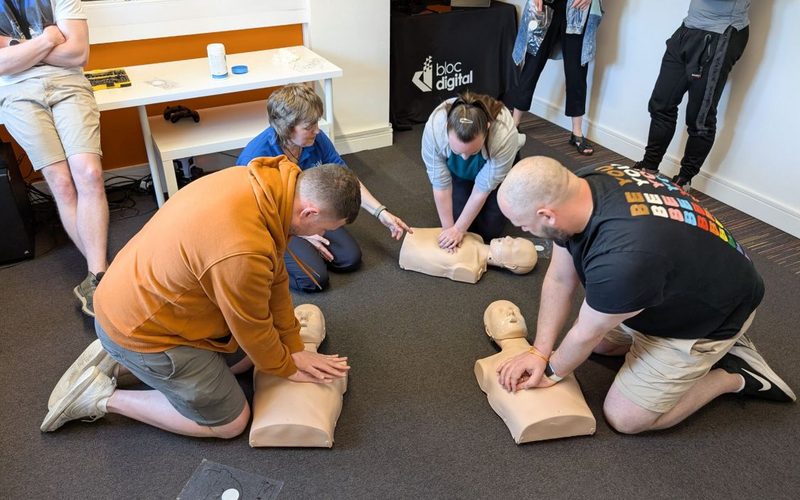
Emergency First Aid at Work (EFAW)
One-day HSE-compliant first aid for lower-risk workplaces. FAIB-accredited certificate valid three years — delivered at your premises.
Ready to book manual handling training at your workplace?
Tell us your location, total team size and preferred dates — we will confirm availability and send a no-obligation fixed-price quote by return. Most enquiries are answered the same working day.